Is Prop Trading a Career or a Side Hustle?
There’s a version of proprietary trading that circulates online: flexible hours, no boss, income that scales as fast as your skill. That version isn’t entirely wrong, but it leaves out most of the picture. A genuine prop trading career involves structured education, deliberate skill-building across markets and timeframes, and a level of psychological discipline that most people don’t anticipate until they’re already in the middle of it.
So where does prop trading actually fit in a person’s professional life? Is it a full career path, a serious side pursuit, or something in between? The answer depends almost entirely on how you approach it, and understanding that distinction early will save you considerable time and frustration.
What a Prop Trading Career Actually Involves
Before mapping out how a prop trading career fits into your life, it helps to be clear about what proprietary trading is and how it actually works. At a professional trading firm, you’re deploying the firm’s capital according to defined risk parameters, with your compensation tied directly to your performance. You are not managing client money, and you are not speculating with your personal savings. Instead, you operate within a structured framework designed to manage risk while giving skilled traders meaningful upside.
That structure matters. It means your results aren’t simply a function of how aggressive you’re willing to be. They reflect how well you read the market, manage your exposure, and execute within the firm’s framework. It’s performance-based work in the most direct sense of the phrase.
The Skill Development Timeline in a Prop Trading Career
One of the most important things to understand about trading as a professional path is that skill development takes time, more time than most people expect, and more time than most online content acknowledges.
Early in a prop trading career, the primary goal isn’t profitability. It’s pattern recognition: learning to read price action, understanding how liquidity moves, and developing intuition about when setups are genuinely high-probability versus when they’re just noise. Most traders who reach consistent performance describe that arc measured in years, not months.
But technical skill is only part of the equation. Two areas tend to separate traders who develop quickly from those who stall: psychology and trade plan development. Understanding chart patterns matters. Knowing what to do when you’re in a losing streak, when you’re overconfident after a strong week, or when your emotions are pulling you toward a trade your rules don’t support: that’s the work that actually determines long-term results. A written trade plan is where those two threads come together: it documents your setups, your entry and exit criteria, your risk tolerances, and gives you something concrete to evaluate after every session. The best trading environments treat both as core disciplines, not optional supplements.
Professional traders often describe this arc like learning a technical craft. Trading has its own version of that progression, and the traders who succeed are typically the ones who respect the timeline rather than trying to shortcut it.
Prop Trading Career vs Side Hustle: Where the Real Line Is
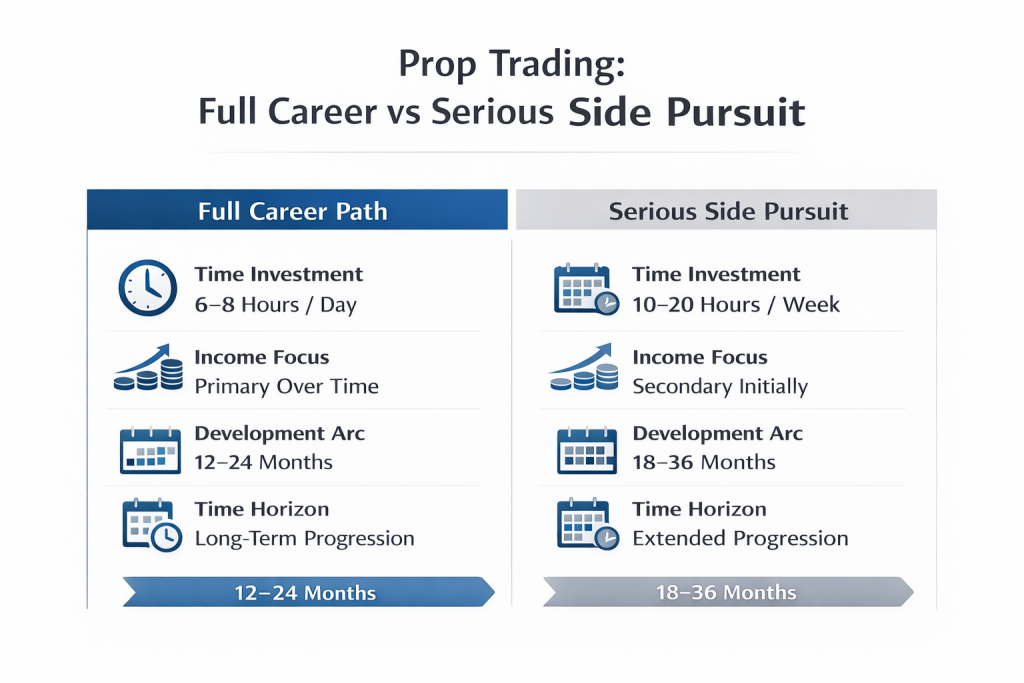
Here’s a useful reframe: the career-versus-side-hustle question isn’t really about the number of hours you put in. It’s about the depth of commitment and quality of attention you’re able to consistently bring to the work.
Some professionals pursue trading as a focused side path during an existing career, allocating dedicated hours each week to developing skills and building a track record. Others commit to it as their primary professional focus from the start. Both approaches can work, but they carry very different development timelines and income expectations.
What doesn’t work is treating prop trading as a casual activity: checking positions intermittently, studying inconsistently, and expecting results to materialize without
deliberate practice. The market doesn’t reward underprepared participants, regardless of how much time has passed.
The traders who succeed at professional firms share one consistent trait, regardless of whether trading was their full-time job or not: they took skill development seriously. The study hours were protected. The performance review was honest. The ego was kept out of it.
Understanding Income Variability vs. Scalability
One of the biggest mental adjustments for people coming from salaried employment is accepting that prop trading income doesn’t follow a predictable schedule. Some weeks are strong. Some months are flat. Market conditions shift, and results shift with them.
This isn’t a flaw in the model. It’s a fundamental feature of performance-based compensation, and it scales in ways that a salary never will. A trader who builds genuine skill and manages risk well has the potential to scale the capital they’re allocated as their track record earns it.
But scalability is a long-game benefit. Early in development, treating trading income as a reliable monthly salary creates the wrong expectations and, more dangerously, the wrong psychology. Experienced traders build financial reserves to buffer variability and measure performance quarterly or annually rather than week to week. This mindset is central to how professional traders think about risk: not just market risk, but the personal financial risk that comes with variable income. Your financial foundation should be stable before that variability becomes a source of pressure, because trading under financial stress is one of the most reliable accelerants of poor decision-making.
Who This Path Is Actually Built For
- Prop trading as a serious pursuit, whether career or side path, fits certain people well and others poorly. Being honest about the fit early saves everyone meaningful time.
- People who are genuinely curious about markets, not just motivated by income potential, tend to develop faster and sustain motivation through difficult stretches. Intrinsic interest compounds over time.
- Psychological resilience is equally important. This is not about eliminating emotion from trading. It is about recognizing how emotional patterns show up under pressure and building habits that prevent them from steering decisions. Traders who pair that self-awareness with a written trade plan often develop greater durability than those who focus purely on technical setups.
- Risk discipline is the final filter. At a professional firm, risk parameters are structural guardrails, not optional suggestions. Traders who internalize that framework tend to scale. Traders who resist it rarely last.
A Realistic Look at the Career Arc
If you’re approaching prop trading as a career path, here’s a grounded way to think about the trajectory.
Phase 1: Orientation. Learning the firm’s systems, understanding the risk framework, and getting exposure to the markets you’ll be trading (stocks, options, forex, or a combination). The focus is building pattern recognition and beginning a written trade plan, which will evolve considerably before it stabilizes.
Phase 2: Development. Trading smaller size, refining your approach based on real performance data, and finding where your edge is genuine versus where you only thought you had one. This is where psychology becomes impossible to ignore. The traders who develop fastest aren’t the most technically gifted. They’re the ones who can review a bad week honestly, spot their own emotional patterns, and adjust before those patterns become costly.
Phase 3: Consistency. Repeatable results across different market conditions, a trade plan grounded in genuine self-knowledge, and a track record that supports capital scaling. This is where the long-term economics of a prop trading career become most compelling.
No fixed timeline applies to everyone. But expecting to move from Phase 1 to Phase 3 in under a year is likely to produce disappointment, along with the forced impatience that undermines development.
The Bottom Line
Prop trading is neither a passive income stream nor a guaranteed professional path. It’s a performance-based discipline that rewards genuine skill development, psychological self-awareness, and long-term commitment, whether you’re pursuing it as your primary focus or as a serious side endeavor alongside an existing career.
The traders who build lasting careers in this space approached it like a profession from the beginning: studying markets deliberately, building and following a trade plan, doing the inner work to understand how their psychology affects their execution, and evaluating their own performance without self-deception. Those aren’t abstract virtues. They’re learnable skills, and the right environment makes a meaningful difference in how quickly and deeply they develop.
If that describes how you naturally approach challenging work, this path is worth exploring seriously.
The right firm doesn’t just give you capital. It gives you the structure, education, and coaching to become the kind of trader who deserves to scale it. Learn what trading with firm capital actually looks like and find out if you’re a fit.
Read: Trading Psychology: Mastering Your Brain Chemistry
More on Trading Psychology
Take the Trader Personality Test
Disclaimer: This content is provided for educational and informational purposes only. It does not constitute, and should not be relied upon as, personalized investment advice, a recommendation to buy or sell any security, or an offer to participate in any trading activity. Trading involves substantial risk, and past performance is not indicative of future results.