
How Capital Allocation Works at a Professional Proprietary Trading Firm
How Capital Allocation Works at a Professional Proprietary Trading Firm
Capital allocation is the structural core of a professional proprietary trading firm.
It determines:
- How risk is deployed
- How traders are scaled
- How exposure is managed
- How the firm preserves long-term stability
In a true professional prop trading firm, capital is not distributed loosely. It is deployed intentionally, monitored continuously, and increased only when data supports expansion.
Understanding how capital allocation works allows you to evaluate whether a firm operates with institutional discipline — or with short-term incentive structures.
What “Firm Capital” Means in a Professional Environment
At a professional proprietary trading firm, capital is drawn directly from the firm’s balance sheet.
That distinction matters.
Balance sheet capital:
- Belongs to the firm
- Carries real financial exposure
- Impacts firm profitability directly
- Requires structured oversight
When a trader is allocated firm capital, the firm is placing real capital at risk under defined parameters.
This creates true alignment: Prop Trading vs. Retail Trading: Key Differences serious traders hould understand
- The firm benefits from sustained trader performance
- The trader benefits from increased allocation
- Both parties benefit from disciplined risk management
This model is explained more broadly in What Is Proprietary Trading — And How It Actually Works, but capital allocation is where the structure becomes operational.
Related Article:
Live Capital vs Simulated Capital
One of the most important distinctions in today’s trading environment is whether capital is deployed live in real markets or whether traders are operating in simulated conditions.
Professional proprietary trading firms allocate live capital.
That means:
- Orders are executed in real market environments
- Liquidity and slippage are real
- Risk exposure impacts the firm’s balance sheet
- Profits and losses are realized in actual markets
In contrast, some industry models operate traders in simulated environments where trades are not executed in live markets.
From an educational standpoint, traders should understand the difference:
| Live Capital | Simulated Capital |
| Real market execution | Simulated pricing feed |
| Real liquidity conditions | No true market impact |
| Firm bears financial risk | No firm capital at risk |
| Profit sharing from trading | Revenue model may differ |
There is nothing inherently wrong with simulation for training purposes.
However, transparency is critical.
A professional proprietary trading firm should clearly disclose:
- Whether capital is live
- How profits are generated
- How risk is absorbed
- How scaling works
Capital structure transparency reflects institutional maturity.

How Professional Firms Fund Capital Allocation
Professional proprietary trading firms typically generate capital through:
- Retained trading profits
- Corporate capital reserves
- Long-term firm growth
- Structured capital reinvestment
Allocation growth is tied to the health of the firm’s overall portfolio.
Capital is not infinite.
It must be preserved to remain deployable.
For that reason, professional firms treat capital allocation as:
A portfolio management decision — not a promotional offering.
The Professional Capital Allocation Ladder
Most professional proprietary trading firms operate on a staged capital ladder.
Stage 1: Initial Allocation
Traders receive defined capital under structured risk controls.
This stage focuses on behavioral data collection and risk reliability.
Stage 2: Stability Validation
The firm evaluates:
- Consistency across time
- Controlled drawdowns
- Strategy adherence
- Emotional composure
- Position sizing discipline
This period allows the firm to observe how a trader behaves in different market regimes.
Stage 3: Structured Scaling
Capital increases incrementally once:
- Risk metrics are stable
- Behavioral data is sufficient
- Strategy durability is demonstrated
Scaling is earned through predictability — not short-term performance spikes.
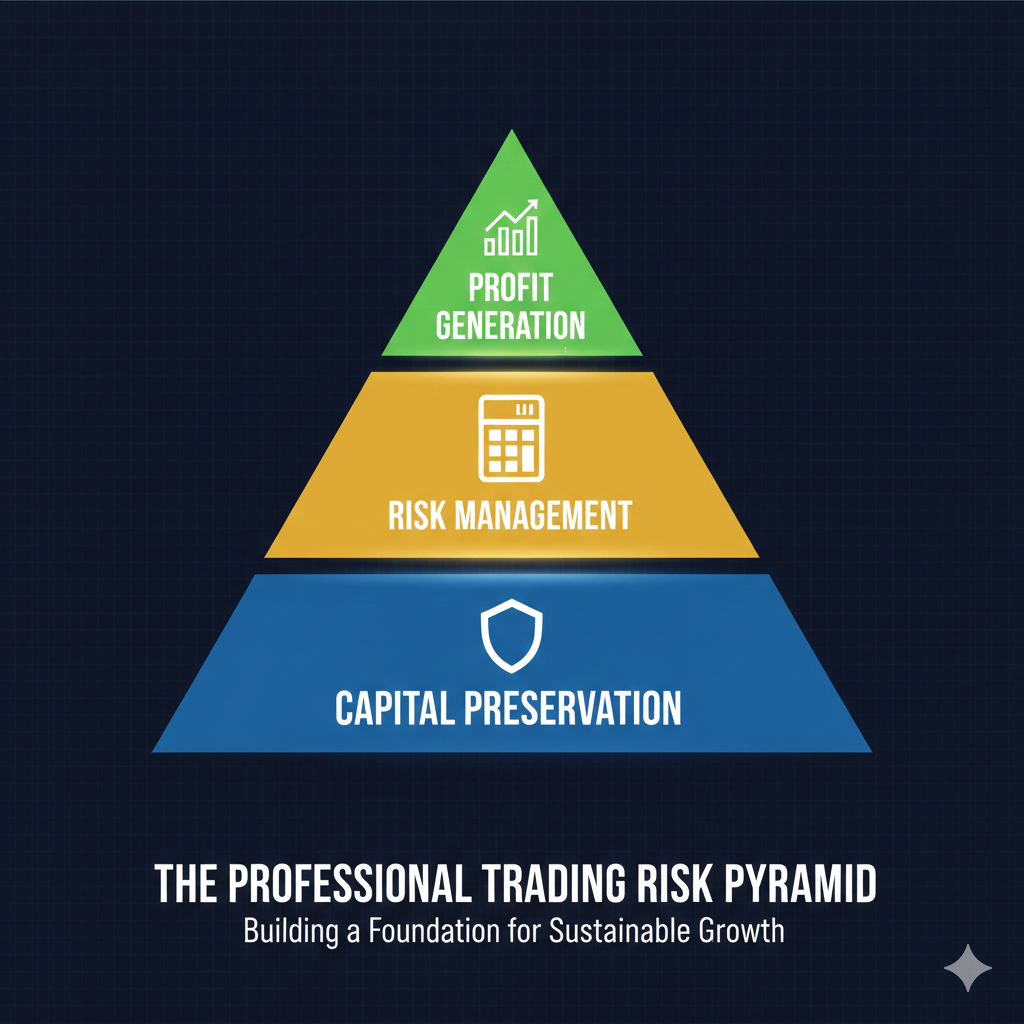
Why Professional Firms Limit Risk — Even for Profitable Traders
In a professional proprietary trading firm, risk limits are structural safeguards.
They exist to protect:
- The firm’s capital
- Other traders’ allocations
- Aggregate exposure
- Business continuity
Common controls include:
Trader-Level Controls
- Daily loss limits
- Maximum drawdown thresholds
- Position sizing caps
- Leverage parameters
Firm-Level Controls
- Asset class exposure caps
- Correlation monitoring
- Strategy concentration limits
- Liquidity-adjusted sizing
Risk limits are not a sign of distrust.
They are a reflection of fiduciary-style discipline applied internally.
This risk-first philosophy is central to How Professional Traders Think About Risk.
The Portfolio Perspective: Capital Allocation in Aggregate
A professional proprietary trading firm does not evaluate traders in isolation.
Leadership monitors:
- Net exposure across asset classes
- Correlated strategy clusters
- Macro event risk concentration
- Currency imbalances
- Liquidity sensitivity
For example:
If multiple traders are positioned in the same direction ahead of a major macro event, firm-level risk managers may adjust exposure thresholds to maintain overall portfolio stability.
Capital allocation decisions therefore consider:
- Individual performance
- Portfolio correlation
- Firm-level exposure balance
Professional firms operate like internal hedge fund structures — even if traders operate independently.
Performance-Based Scaling: Why It Is Measured
Scaling is often misunderstood as rapid expansion.
In a professional proprietary trading firm, scaling is:
- Data-driven
- Risk-adjusted
- Gradual
- Verified
Aggressive scaling increases concentration risk.
Measured scaling allows:
- Strategy validation across market cycles
- Behavioral reliability confirmation
- Drawdown resilience testing
Capital increases follow observed stability — not enthusiasm.
A Professional Caution on Incentive Structures
When evaluating capital allocation models, it is important to understand how firms generate revenue.
In a professional proprietary trading firm:
- Revenue comes from profit sharing
- Growth depends on trader longevity
- Risk must be preserved for sustainability
In other models within the industry, revenue structures may emphasize:
- Entry or evaluation fees
- Short-term performance thresholds
- Repeated assessment cycles
These structures create different incentive alignments.
If a firm’s revenue depends primarily on evaluation cycles rather than long-term trader profitability, its capital allocation incentives may differ from those of a traditional professional proprietary firm.
Traders should ask:
- Is capital deployed live?
- How does the firm make money?
- What percentage of revenue comes from trader performance vs other sources?
- How long do funded traders typically remain active?
Professional transparency is a hallmark of institutional discipline.
Why Capital Is Not Allocated Aggressively at the Start
Professional firms allocate conservatively at the beginning for three reasons:
- Behavioral data is limited.
- Strategy durability has not yet been observed at scale.
- Market conditions are always evolving.
Capital increases reflect earned trust.
Trust in financial markets is built on repeatable behavior under pressure.
What Determines Initial Allocation Size?
Initial allocation decisions typically evaluate:
- Verified track record
- Risk-adjusted return profile
- Strategy volatility
- Asset class specialization
- Documented risk framework
Traders are assessed as capital stewards — not as test participants.
If you are unsure whether your approach aligns with a professional proprietary environment, review Who Succeeds at a Proprietary Trading Firm.
Capital Allocation Reflects the Firm’s Identity
Ultimately, capital allocation reveals a firm’s philosophy.
If scaling is structured, transparent, and data-driven, the firm likely operates with long-term orientation.
If allocation appears promotional, opaque, or event-based, incentive structures may differ.
Professional proprietary trading firms treat capital as:
- An inventory asset
- A risk-managed portfolio component
- A strategic growth lever
- A long-term partnership tool
Not as a marketing feature.
Related Article: What is Prop Trading and How it Actually Works
Apply to Trade with Firm Capital
Professional firm capital is allocated to traders who demonstrate:
- Risk discipline
- Consistency across time
- Emotional stability
- Structured execution
If your approach aligns with a performance-based capital model built for long-term sustainability, you may apply to trade with firm capital.
Capital follows structure.
Structure supports longevity.