Get answers to common questions about proprietary trading with Maverick Trading’s Prop Trading Q&A. Learn about strategies, risks, and how to succeed as a prop trader.
Most people look at prop trading and see opportunity. More buying power. More trades. More upside. Professional firms see something else first: risk. That is because proprietary trading firms do not succeed by avoiding losses altogether. They succeed by managing risk across thousands of trades in a way that keeps capital protected, decision-making disciplined, and…
One of the most common questions new traders ask is how long to become a consistent trader. It is a fair question, but the honest answer is that there is no universal timeline. Consistency in trading is not a destination you reach after a fixed number of months. It is a standard you build, maintain,…
Most people’s picture of a professional trader is shaped by movies and highlight reels: fast money, instant decisions, and dramatic swings. The reality is both more demanding and more structured than that. A professional trading career follows identifiable phases, requires sustained psychological development, and involves income variability that most candidates don’t anticipate. Understanding what a…
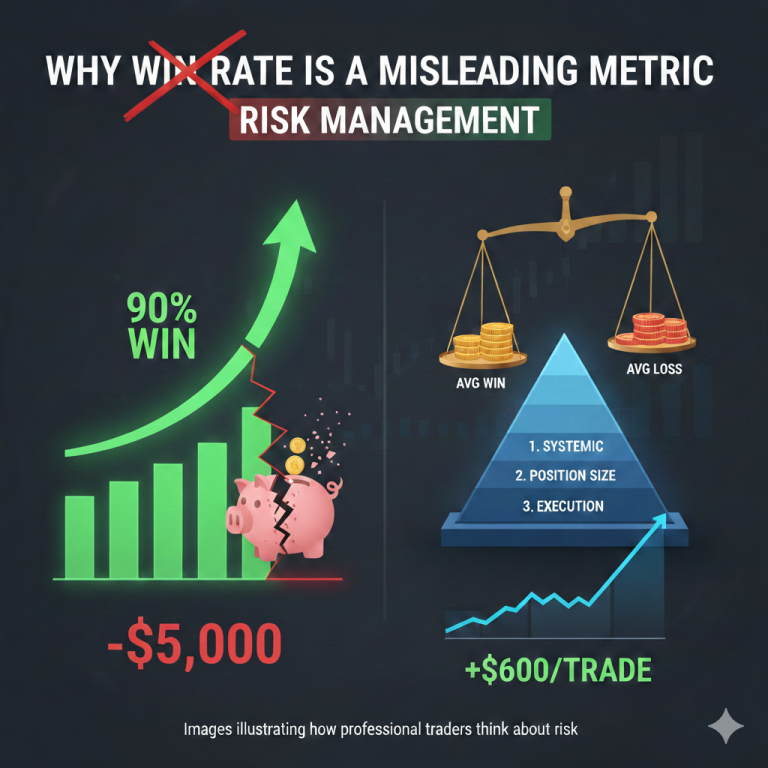
Win Rate vs Risk Management: Why Win Rate Is a Misleading Metric in Trading In the world of retail trading, the “win rate” is often treated as the ultimate badge of honor. Marketing materials and social media influencers frequently flaunt hit rates of 80% or 90%, suggesting that the secret to wealth is simply being…
Is Prop Trading a Career or a Side Hustle? There’s a version of proprietary trading that circulates online: flexible hours, no boss, income that scales as fast as your skill. That version isn’t entirely wrong, but it leaves out most of the picture. A genuine prop trading career involves structured education, deliberate skill-building across markets…
How Proprietary Trading Firms Make Money How proprietary trading firms make money — and how are incentives structured? It’s an important question. Because the answer tells you everything about: Understanding the economics behind proprietary trading helps you distinguish between professional capital allocation firms and models built primarily around fees or simulations. Let’s break it down…
How Capital Allocation Works at a Professional Proprietary Trading Firm Capital allocation is the structural core of a professional proprietary trading firm. It determines: In a true professional prop trading firm, capital is not distributed loosely. It is deployed intentionally, monitored continuously, and increased only when data supports expansion. Understanding how capital allocation works allows…
How Professional Traders Think About Risk: The Architecture of Capital Preservation When you step into the world of institutional finance, the first thing you notice isn’t the flashing green lights or the thrill of a big win. Instead, you will see a quiet, methodical focus on the exit. Most retail traders enter a trade wondering…