Win Rate vs Risk Management: Why Win Rate Is a Misleading Metric in Trading
In the world of retail trading, the “win rate” is often treated as the ultimate badge of honor. Marketing materials and social media influencers frequently flaunt hit rates of 80% or 90%, suggesting that the secret to wealth is simply being “right” more often than you are “wrong.” However, in a professional proprietary trading environment, these figures are viewed with extreme skepticism. The reality is that win rate, in isolation, is one of the most misleading metrics in the financial markets.
To achieve longevity, a trader must undergo a fundamental shift in perspective: moving away from the vanity of a high hit rate and toward the structural integrity of win rate vs risk management. This guide explores why hit rates are secondary to mathematical expectancy and how professional capital managers protect themselves from the “Accuracy Trap.”
High Win Rate vs. Profitability: The Great Illusion
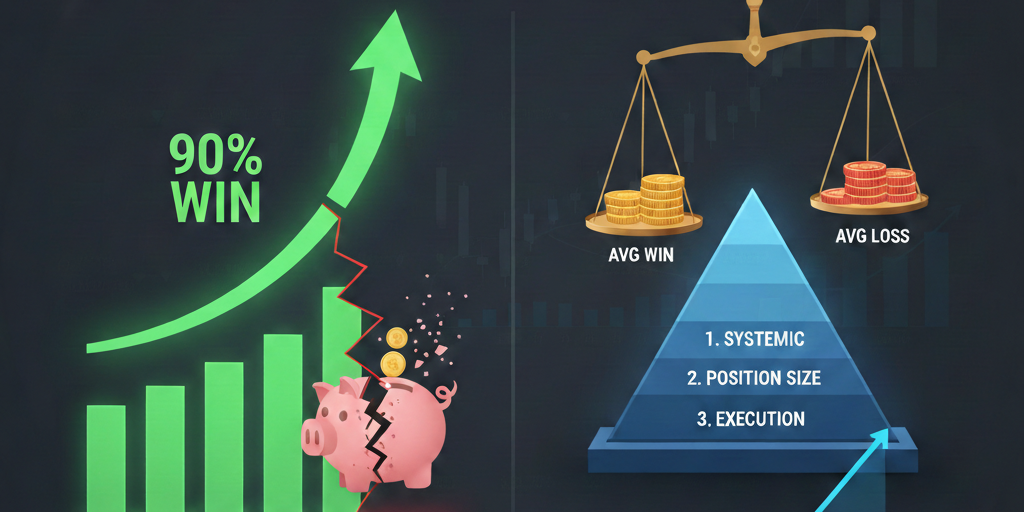
The core problem with obsessing over a high win rate is that it ignores the magnitude of individual outcomes. You can be right 9 out of 10 times, but if your one losing trade wipes out the profits from your nine winners plus a portion of your principal, you are mathematically insolvent.
Many retail strategies achieve a high win rate by “averaging down” or refusing to take a stop-loss until a trade returns to breakeven. While this produces a beautiful-looking equity curve in the short term, it creates a “left-tail” risk—the statistical probability of a single, massive outlier event that clears out the account. Consequently, these traders are not actually trading; they are simply picking up pennies in front of a steamroller. When we analyze win rate vs risk management, we find that the most profitable institutional desks often have win rates between 35% and 50%. They aren’t right more often; they simply ensure that their “right” is much larger than their “wrong.”
Expectancy vs. Hit Rate: The Professional’s Ledger
Professional traders do not look for “winning” trades; they look for positive expectancy. Expectancy is the average amount you can expect to win (or lose) per trade, factored over hundreds of executions. This is where the debate of win rate vs risk management is won or lost.
To calculate your edge, you must look at the Expectancy Formula:
E = (Pwin × Avg Win) — (Ploss × Avg Loss)
Connecting the Data Points
To understand this formula, you must derive the numbers from your actual trade history of over a sample of at least 50-100 trades:
Pwin (Win Rate): Total winning trades / Total trades taken.
Avg Win: Total $ profit from wins / Number of winning trades.
Ploss (Loss Rate): Total losing trades / Total trades taken.
Avg Loss: Total $ loss from losers / Number of losing trades.
On top of that, once you view your trading through this lens, the psychological pressure to be “accurate” disappears. If you know that your Avg Win is $3,000 and your Avg Loss is $1,000, a 40% win rate is a gold mine. In this scenario, for every 10 trades, you bank $12,000 and give back $6,000.
This means your net expectancy is $600 per trade. The professional trader treats a loss as a minor business expense—just a necessary data point in a winning mathematical model. Instead of fearing the 60% of trades that lose, they focus on the $600 “profit” baked into every single click of the mouse.
The Variance Trap: Surviving the Statistical Cluster
Even with a perfect understanding of win rate vs risk management, many traders fail because they do not account for Variance. Variance is the “clumpiness” of random outcomes. Even with a 60% win rate, it is statistically possible—and even likely—to encounter a string of 6 or 7 consecutive losses within a sample of 100 trades.
Retail traders often abandon a profitable strategy during these clusters because they believe the strategy is “broken.” In contrast, a professional understands that as long as the Avg Loss remains within the pre-defined parameters, the strategy is performing exactly as expected. They don’t react to the cluster; they react to the expectancy. If you lack a deep focus on risk management, a normal string of losses will trigger an emotional liquidation of your strategy right before the “win” cluster arrives.
The Mechanics of Positive Skew: Why “Big Wins” Matter
When comparing win rate vs risk management, the ultimate goal is to create “Positive Skewness.” In statistics, this means the tail of your winning trades is much longer than the tail of your losing trades.
The Power of the Outlier
In a professional portfolio, 80% of your profits often come from 20% of your trades. This is the Pareto Principle applied to markets. If you are obsessed with a high win rate, you will often “cut your winners” early to secure the psychological win. However, doing so removes the very outliers that make the math work. By cutting a winner at $500 when your model dictates it could go to $2,500, you are artificially lowering your Avg Win variable. This forces you to have a higher win rate just to stay at breakeven. Instead, the professional lets the winner run, accepting that their win rate might drop, but their total profitability will soar.
The Asymmetry of Loss and Capital Preservation
The reason win rate vs risk management is such a critical concept is due to the Asymmetry of Loss. When a trader prioritizes win rate, they often invert their risk-to-reward ratio. They risk $5 to make $1. This creates a psychological environment where the trader becomes a slave to their hit rate.
If you have a 90% win rate but a 1:10 risk-to-reward ratio, your “edge” is non-existent. Instead, professional traders aim for positive skewness. By maintaining a 1:3 or 1:5 ratio, they provide themselves with a massive margin for error. This buffer allows them to survive the “losing streaks” that are a statistical certainty in any market environment. Because professional traders think about risk as the primary driver of returns, they prioritize the protection of capital over the validation of their ego.
The Institutional Feedback Loop: Reviewing the Spread
At a proprietary firm, the review process is never about “Why did you lose this trade?” It is about “Did this loss exceed your Avg Loss?” and “Did you execute the exit according to the plan?”
When we look at What is Propriety Trading: Firms, Payouts & Risks, the survivors are those who can sit through 5 losses in a row without changing their position sizing. They understand that win rate vs risk management is a long-term game. If the “Revenue” (Avg Win) is still outperforming the “Expenses” (Avg Loss), the business is healthy. The moment a trader tries to “fix” their win rate by widening a stop-loss, they have moved from professional management into high-stakes gambling.
Emotional Overconfidence and the “Accuracy Trap”
Focusing on win rate creates a dangerous emotional feedback loop. Every win provides a hit of dopamine, reinforcing the belief that the trader has “figured out” the market. As a result, when the inevitable string of losses arrives, the trader is emotionally unprepared. They begin to view losses as personal failures rather than statistical offsets.
This overconfidence often leads to:
-
Revenge Trading: Trying to “win back” the money to restore the high win rate.
-
Hesitation: Fear of taking the next signal because it might “break” the winning streak.
-
Position Sizing Errors: Increasing size after a win streak due to a false sense of invincibility.
Ultimately, the shift from retail to professional requires abandoning the need to be right. A professional trader accepts that the market is a probabilistic environment where any single trade outcome is essentially a coin flip. Their only job is to ensure that the win rate vs risk management equation remains skewed in their favor over the long term.
Mastering the Sanity Metric
Win rate is a vanity metric; expectancy is a sanity metric. By moving your focus away from being “right” and toward the relationship of win rate vs risk management, you remove the emotional volatility that destroys most retail accounts. You begin to treat trading as a high-volume business where small, controlled losses are the cost of goods sold, and large, disciplined wins are the revenue.
The market does not reward those who are right most often; it rewards those who can manage the math of uncertainty. Read How Professional Traders Manage Risk. If you can manage risk, you are already ahead of 90% of the participants in the global markets.
Apply to Trade with Firm Capital
More on Trading Psychology
Take the Trader Personality Test
Read:
Psychological Traits of Top Traders: 8 Key Traits You Need to Succeed
10 Essential Skills Every Profitable Trader Must Master
Top 12 Habits of Successful Traders
How to Get Started Trading Options
Disclaimer: This content is provided for educational and informational purposes only. It does not constitute, and should not be relied upon as, personalized investment advice, a recommendation to buy or sell any security, or an offer to participate in any trading activity. Trading involves substantial risk, and past performance is not indicative of future results.