Risk scaling is one of the most misunderstood aspects of trading. Many retail traders focus heavily on entries, strategies, and indicators—but far fewer understand how to properly increase position size over time without exposing themselves to disproportionate risk.
This is where the concept of retail trading risk scaling becomes critical. It’s not just about growing an account, it’s about doing so in a way that preserves longevity. For most retail traders, the structure they operate within makes this far more difficult than it appears on the surface.
The Hidden Challenge of Capital Concentration Risk
Retail traders typically operate with limited capital. Whether it’s $1,000 or $50,000, the account size directly influences how risk is deployed.
This creates capital concentration risk—a situation where a large percentage of total capital is exposed in each trade.
For example:
- A trader risking 2% per trade on a $5,000 account is risking $100
- To generate meaningful returns, they may feel pressure to increase position size
- This often leads to overexposure in a small number of trades
The issue isn’t the percentage itself—it’s the impact of that percentage relative to total capital. A few losses in a row can significantly impair the account, making recovery increasingly difficult.
In contrast, larger capital bases allow for:
- More diversification across trades
- Lower relative exposure per position
- Greater resilience during losing streaks
Retail traders don’t lack discipline—they often lack the structural flexibility to distribute risk effectively.
Psychological Pressure Intensifies with Size
As position size increases, so does emotional intensity.
For retail traders, scaling risk isn’t just a mathematical decision—it’s a psychological one. Each incremental increase in size introduces new pressure:
- Fear of loss becomes more pronounced
- Decision-making becomes less objective
- Execution consistency declines
A trader who performs well risking $50 per trade may struggle when risking $500—not because their strategy changed, but because their emotional tolerance threshold was exceeded.
This creates a common cycle:
- Gradual account growth
- Increase in position size
- Emotional disruption
- Performance breakdown
The result is often a return to smaller size—or worse, a significant drawdown.
Drawdown Amplification: The Compounding Effect
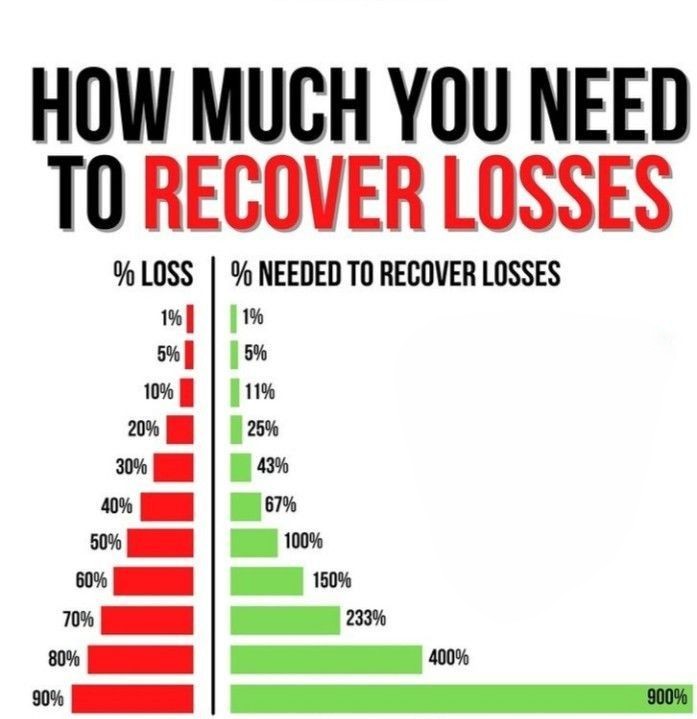
Drawdowns are a natural part of trading. However, when risk is scaled improperly, drawdowns become amplified in ways that are difficult to recover from.
Consider this:
- A 10% loss requires an 11.1% gain to recover
- A 25% loss requires a 33.3% gain
- A 50% loss requires a 100% gain
As risk increases, so does the potential for larger drawdowns—and the math becomes unforgiving.
Retail traders often encounter this when:
- Increasing position size too quickly
- Trading with inconsistent risk parameters
- Attempting to “accelerate” growth after losses
This leads to a dangerous feedback loop:
- Larger losses → Increased pressure → Poor decisions → Even larger losses
Drawdown isn’t just a performance metric—it directly impacts a trader’s ability to continue scaling.
The Reality of Scaling Math
Scaling in trading is not linear—it’s exponential and highly sensitive to risk.
Many retail traders assume that:
- Doubling account size = doubling position size
- Increasing size = proportional increase in profits
In reality, scaling requires balancing three variables:
- Win rate
- Risk per trade
- Drawdown tolerance
Even small adjustments in risk can drastically alter outcomes.
For example:
- Increasing risk from 1% to 2% per trade does not simply double returns
- It significantly increases volatility and drawdown potential
This is where many traders run into trouble. The math of scaling punishes inconsistency. Without strict risk control, growth becomes unstable.
Additionally, smaller accounts face a structural limitation:
- The need to take on higher relative risk to achieve meaningful returns
This creates a paradox:
- To grow, risk must increase
- But increasing risk threatens sustainability
Why Structure Changes Outcomes
One of the most overlooked aspects of trading success is structure—specifically, the environment in which capital is deployed.
Retail traders operate under constraints:
- Limited capital
- Personal financial pressure
- Lack of risk-sharing mechanisms
These constraints directly impact how risk scaling is approached.
In more structured environments (such as firm-backed trading models), traders often benefit from:
- Access to larger capital pools
- Defined risk parameters
- Reduced personal financial exposure
This changes the equation entirely.
Instead of needing to aggressively scale a small account, traders can:
- Focus on consistency over growth speed
- Maintain stable risk levels
- Let capital access—not risk escalation—drive returns
The difference is subtle but powerful:
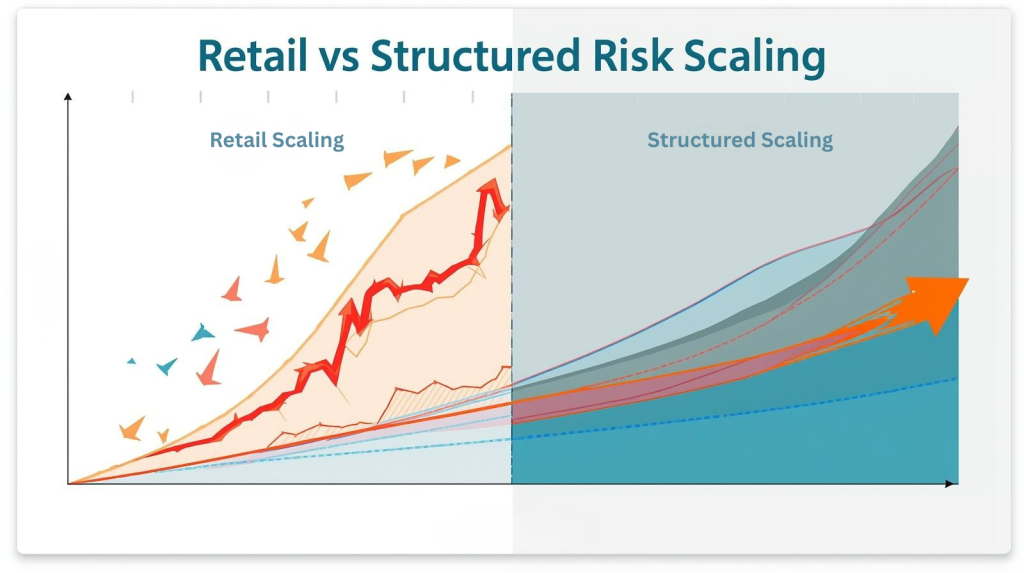
- Retail model: Growth requires increasing risk
- Structured model: Growth comes from scaling capital access
This distinction is at the core of why many retail traders struggle with long-term scaling.
Bridging the Gap: What Retail Traders Can Do
While structural limitations are real, there are still ways retail traders can improve their approach to risk scaling.
1. Prioritize Risk Consistency Over Growth Speed
Avoid increasing position size simply because the account has grown. Stability matters more than acceleration.
2. Use Fixed Risk Percentages Thoughtfully
A fixed percentage model can help—but only if it aligns with your emotional tolerance and strategy performance.
3. Track Drawdown as a Primary Metric
Don’t just measure profits. Monitor how much you lose—and how quickly you recover.
4. Scale in Phases, Not Continuously
Instead of gradually increasing size, move in defined steps after proven consistency.
5. Separate Performance From Capital
Whenever possible, evaluate your trading skill independently from account size. This helps reduce emotional bias.
Retail trading risk scaling is not just a technical challenge—it’s a structural one.
Most traders don’t fail because they lack strategy. They struggle because:
- Their capital base forces higher relative risk
- Psychological pressure increases with size
- Drawdowns compound faster than expected
- Scaling math becomes unforgiving
Understanding these dynamics doesn’t eliminate the challenge—but it does create clarity.
And with clarity comes better decision-making.
If you’ve found that scaling risk in a small account is limiting your growth, it may be worth exploring alternative structures.
Trading with firm capital allows you to:
- Focus on execution rather than account survival
- Maintain consistent risk levels
- Scale results without increasing personal exposure
Apply to Trade with Firm Capital and shift the way you approach growth—through structure, not pressure.