Who Succeeds in Proprietary Trading?
The image of a successful trader often involves a lone wolf making impulsive, high-stakes decisions fueled by innate genius. Popular culture frequently perpetuates this myth of the “natural-born” trader with a sixth sense for market direction. However, in the rigorous environment of proprietary trading firms, raw talent or gut instinct is rarely enough. Success isn’t about brilliance; it’s about adherence to a process, relentless self-assessment, and a deep, unwavering commitment to risk management.
So, who succeeds in proprietary trading? The answer isn’t who you might expect. It’s not necessarily the most intelligent person in the room, nor the one with the highest win rate. Instead, it’s the disciplined, the adaptable, and the emotionally resilient individuals who consistently execute a well-defined process.
The Illusion of the “Genius Trader”
Many aspiring traders believe that success hinges on an ability to predict market movements with uncanny accuracy. This leads to an unhealthy obsession with being “right” on every trade. As we have seen in our analysis of why Win Rate Is a Misleading Metric in Trading, the market is a complex adaptive system that is inherently unpredictable in the short term. Trying to outsmart it consistently is a fool’s errand.
The reality is that who succeeds in proprietary trading rarely relies on prophetic abilities. Instead, they operate with a probabilistic mindset. They understand that any single trade is an uncertain event. Their edge comes not from foretelling the future, but from consistently applying a statistically validated strategy and managing capital effectively.
Discipline: The Unsung Hero of Performance
If there’s one defining trait among those who succeeds in proprietary trading, it’s unwavering discipline. This isn’t just about following rules when it’s easy; it’s about maintaining consistency when faced with losing streaks, market volatility, or the temptation to deviate.
The Power of a Structured Plan
Discipline is inextricably linked to having a Trading Plan for Consistency. A comprehensive plan acts as an externalized decision-making framework, dictating entries, exits, position sizing, and risk parameters. For instance, a disciplined trader will:
-
Execute Stop-Losses Without Hesitation: Regardless of hope, a stop-loss is taken when the criteria are met to protect the mathematical expectancy.
-
Adhere to Position Sizing Rules: No emotional over-leveraging after a win, nor shrinking size out of fear after a loss.
-
Avoid “Revenge Trading”: Chasing losses only compounds errors and deviates from the statistical edge.
This means discipline provides the structural integrity that allows a trading strategy to perform its statistical function. Without it, even a highly profitable strategy will eventually succumb to human error and emotional impulses.
The Probability Mindset vs. The Gambling Mindset
To understand who succeeds in proprietary trading, you have to distinguish between those who treat the market as a casino and those who treat it as a laboratory. The “gambler” is focused on the excitement of the win and the pain of the loss. The professional is focused on the quality of the execution.
On top of that, the professional trader views their performance as a rolling average. They do not get high on a three-day winning streak because they know that streak is a statistically normal occurrence. Likewise, they do not get depressed during a drawdown. They know that if they have a positive expectancy, the math will eventually clear the path to new equity highs—as long as they don’t blow up their account first.
Adaptability: The Evolving Edge
While discipline provides stability, markets are dynamic. What worked yesterday might not work today. As a result, another crucial characteristic of who succeeds in proprietary trading is adaptability. This doesn’t mean changing strategies impulsively, but rather having the humility to:
-
Review and Refine: Systematically tweak strategy parameters without compromising core principles.
-
Embrace New Information: Be open to new data and evolving quantitative insights.
-
Understand Regime Shifts: Recognize when market behavior fundamentally changes (e.g., from trending to range-bound).
In contrast to the rigid adherence of an amateur, the adaptable professional isn’t just following rules; they’re constantly evaluating the effectiveness of those rules against current market realities.
Emotional Resilience: The Mind’s Fortitude
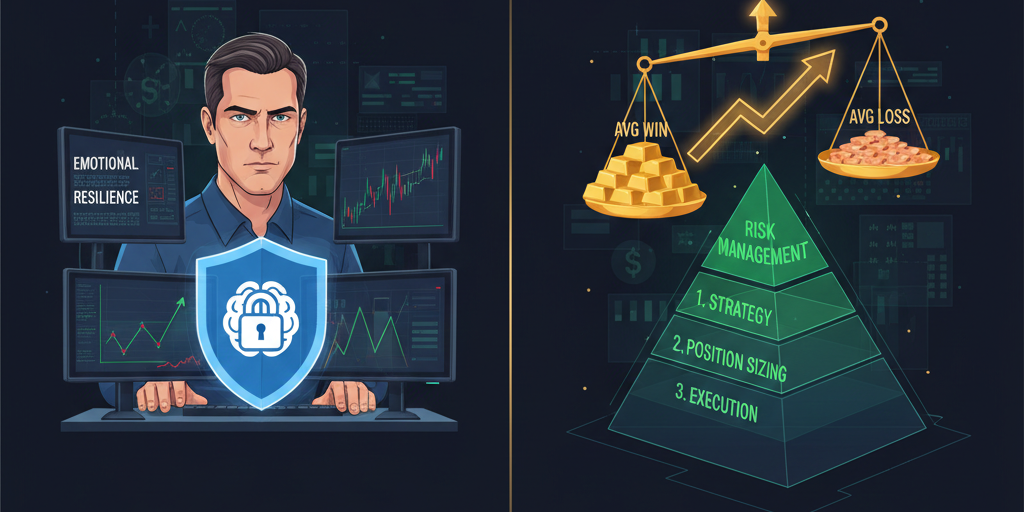
Trading is psychologically brutal. Losses are guaranteed, and the temptation to succumb to fear or greed is ever-present. This is precisely why emotional resilience is a hallmark of who succeeds in proprietary trading.
Managing the Drawdown
Understanding risk management principles, and knowing that in order to recover from deep drawdowns requires exponentially higher gains. Risk management is crucial. This is why the ability to remain rational through a string of losses is paramount.
Resilient traders:
-
Process Losses Objectively: They view losses as data points, not personal failures.
-
Maintain Confidence in Their Edge: They understand that drawdowns are a natural part of a probabilistic system.
-
Practice Self-Awareness: They recognize when their emotional state is compromised and step away to prevent impulsive decisions.
Indeed, the mental game is often more challenging than the intellectual one. The consistent application of risk management principles, even under duress, is a testament to strong emotional fortitude.
The Risk Manager’s Mindset: Protecting Capital First
Ultimately, who succeeds in proprietary trading are capital protectors first, and profit generators second. This fundamental mindset shift aligns perfectly with the institutional Risk Management approach. Success in this field isn’t about how much you can make when you’re right; it’s about how little you lose when you’re inevitably wrong.
Professional traders operate with four non-negotiable mental pillars:
-
Expectancy Over Accuracy: They stop caring about their “win rate.” They know that success is measured by the bottom line, not the ego boost of a high-hit ratio.
-
Position Sizing as the Primary Tool: They treat risk as a volume knob. Instead of trying to “predict” the next big move, they manage their exposure so that no single event can cripple their account.
-
The “Cost of Carry” Philosophy: They view every losing trade as a small, predetermined fee paid to the market for the chance at a larger win. It’s a business expense, not a personal failure.
-
Continuous Refinement: They treat their “edge” as a living document. They are constantly updating their approach based on hard data.
This means that performance reviews at a proprietary firm focus less on individual trade outcomes and more on adherence to process.
The Importance of Quantitative Self-Analysis
You cannot manage what you do not measure. A key differentiator in who succeeds in proprietary trading is their commitment to data. Professionals keep meticulous records of their trades—not just the entries and exits, but the market conditions, their emotional state, and the “slippage” they experienced.
By analyzing this data, they can find “leaks” in their performance. For instance, they might discover they lose money on Fridays or that they tend to over-trade after a large win. Correcting these small leaks is often what separates the break-even trader from the top-tier professional.
Why Proprietary Firms Seek These Traits
Proprietary trading firms are not looking for gamblers. They are looking for disciplined, adaptable, and emotionally resilient individuals who can consistently execute a strategy under pressure. They provide the capital, but the individual must bring the consistent methodology.
The firm’s capital is a precious resource. Those who succeed in proprietary trading understand this implicitly. They see themselves as stewards of that capital, responsible for generating consistent, risk-adjusted returns, rather than chasing erratic, high-percentage wins.
The Path to Consistent Profitability
The myth of the “genius trader” is a dangerous one. The reality of who succeeds in proprietary trading is far more grounded: it’s about persistent discipline, intelligent adaptability, and robust emotional resilience. These are the qualities that allow a trader to consistently execute a positive expectancy strategy and achieve long-term profitability.
If you are ready to cultivate these traits and align your trading philosophy with institutional Risk Management, your journey toward sustained success begins now.
Apply to Trade with Firm Capital
More on Trading Psychology
Take the Trader Personality Test
Read:
Psychological Traits of Top Traders: 8 Key Traits You Need to Succeed
10 Essential Skills Every Profitable Trader Must Master
Top 12 Habits of Successful Traders
How to Get Started Trading Options
Disclaimer: This content is provided for educational and informational purposes only. It does not constitute, and should not be relied upon as, personalized investment advice, a recommendation to buy or sell any security, or an offer to participate in any trading activity. Trading involves substantial risk, and past performance is not indicative of future results.