One of the most common questions new traders ask is how long to become a consistent trader. It is a fair question, but the honest answer is that there is no universal timeline. Consistency in trading is not a destination you reach after a fixed number of months. It is a standard you build, maintain, and continuously defend.
What the data and experience of professional traders does tell us is this: the path is longer than most people expect, shorter than many fear, and heavily shaped by the environment in which you develop. Understanding what that path actually looks like is essential for anyone who is serious about what a professional trading career actually looks like and what it takes to get there.
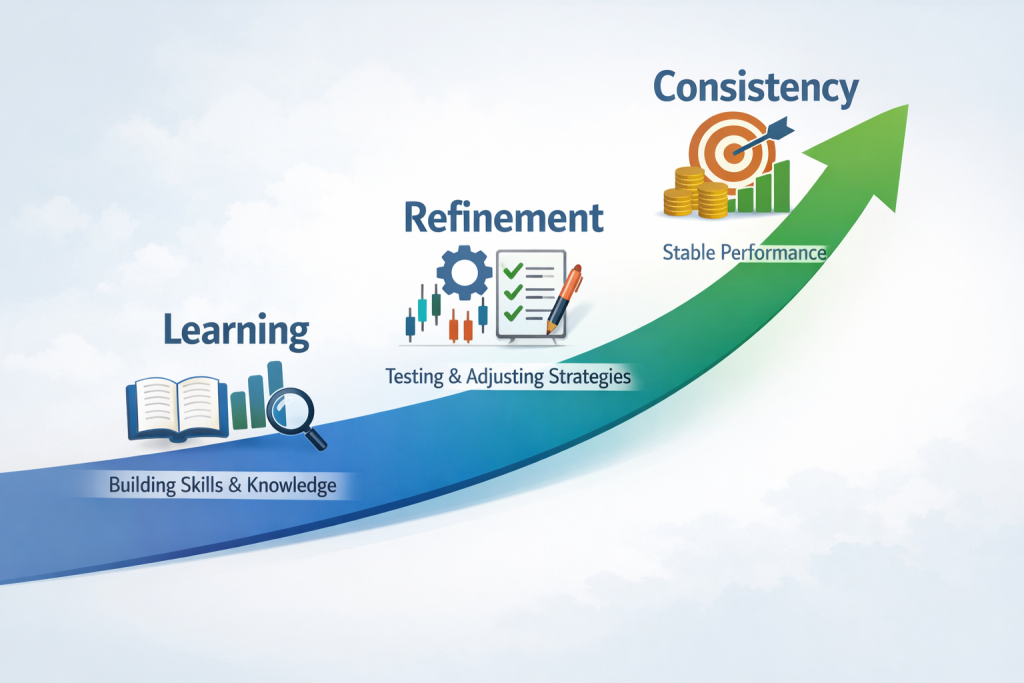
Skill Development Phases on the Path to Consistent Trading
Becoming a consistent trader unfolds in recognizable phases, even if the duration of each varies from person to person.
Foundation (Months 1–6)
In the early stage, you are learning the mechanics. You are absorbing market structure, order flow, technical and/or fundamental frameworks, and basic risk principles. Most traders are still losing money here, and that is normal. The goal is not profitability yet. The goal is building a mental model of how markets behave and developing the discipline to follow a process even when it feels uncomfortable. Traders who try to rush through this phase by focusing purely on returns often carry foundational gaps that show up later in costly ways.
Refinement (Months 6–18)
This is where most traders spend the most time, and where many quit. You now have a strategy, but it does not yet feel automatic. You are still making reactive decisions under pressure, overriding your own rules, and learning what emotional tendencies you bring to the desk. Refinement is the work of translating knowledge into repeatable behavior. It requires you to sit with losses that feel wrong, pass on trades that look right but fall outside your criteria, and keep showing up to review your performance honestly when the results are not what you hoped for.
Consistency (18 Months+)
True consistency does not mean winning every trade. It means executing your process reliably across a large sample: through drawdowns, slow markets, and high-volatility sessions. It means your results are a function of your system, not your mood. Most traders begin to show genuine consistency somewhere between 18 months and 3 years of focused development, assuming they are trading regularly, reviewing performance, and receiving meaningful feedback.
Capital Discipline: The Growth That Takes Longest
Technical skill often develops faster than capital discipline. You can learn to read a chart in weeks. Learning to size a position appropriately when you are down three days in a row takes much longer. The reason is that capital discipline is not purely a knowledge problem. It is a behavioral one. You can understand position sizing intellectually and still blow past your limits when you are frustrated, overconfident, or trying to make back a loss.
Capital discipline is the ability to protect your account when your edge is not present and deploy it confidently when it is. It involves:
- Respecting daily loss limits even when you believe the setup is there
- Scaling into conviction trades rather than swinging for home runs
- Recovering from drawdowns systematically rather than emotionally
- Maintaining process integrity when results are choppy
These behaviors require repeated exposure to real market conditions, not simulated ones. They are best developed within a framework that holds you accountable to them on a daily basis. It is also worth understanding why so many traders struggle to get there: risk scaling is one of the most common and costly blind spots in retail trading.
Emotional Growth Is Non-Negotiable for Consistent Traders
No trader becomes consistent without doing emotional work. Markets are designed, by nature and not by intent, to trigger impulsive decisions. Volatility creates urgency. Losses create the desire to recover. Winning streaks create overconfidence.
Emotional maturity in trading is not about suppressing emotion. It is about recognizing emotional states and understanding how they affect your decision-making in real time. A trader who knows they tend to overtrade after a losing morning has an edge over one who does not. But that self-knowledge only comes from paying close attention to your own behavior across hundreds of trades, not from reading about it. This kind of self-awareness is built through experience, reflection, and often through coaching or mentorship.
Traders who work in structured environments often develop this faster because they have access to feedback that is both timely and specific. When a senior trader or risk manager can identify a pattern in your behavior, such as revenge trading after a loss, and name it before it becomes a habit, you compress months of painful self-discovery into weeks.
How Long to Become a Consistent Trader: Realistic Time Horizons
It is worth being direct about what the realistic range looks like:
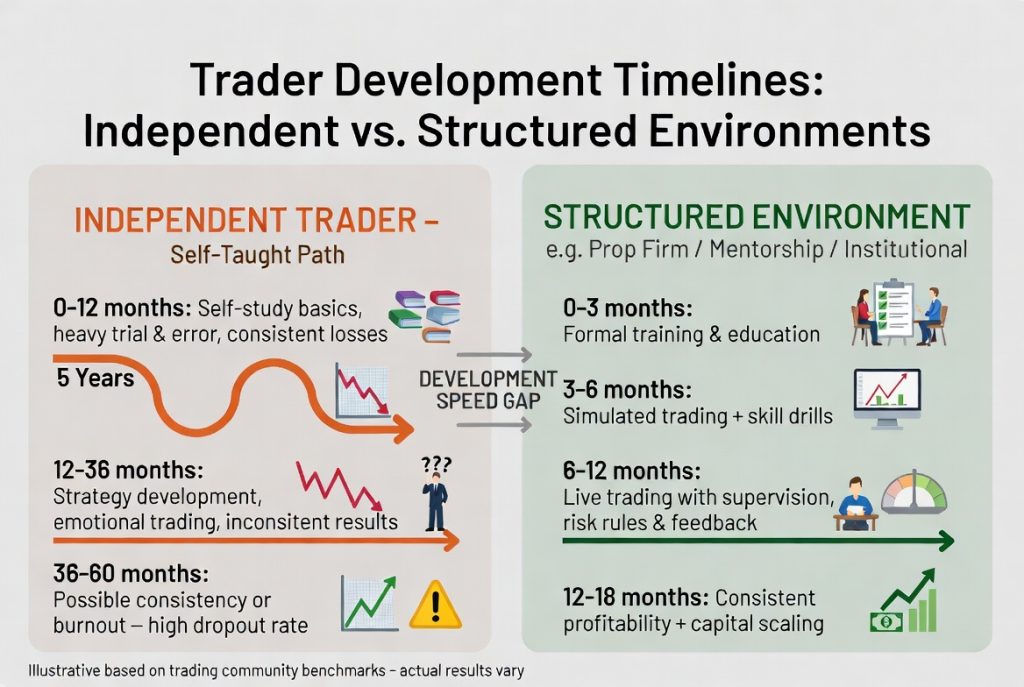
- Traders who develop quickly (typically those with strong foundational discipline, a structured learning environment, and access to quality feedback) can show genuine consistency within 12 to 18 months.
- Most traders developing independently take 2 to 4 years before they can honestly describe their results as consistent.
- Traders who lack structured accountability, risk frameworks, or real capital exposure may spend years without ever closing the gap between skill and consistency.
None of these ranges are promises. They are patterns observed across trading professionals. Your timeline will be shaped by the quality and intensity of your development, not just its duration.
It is also worth acknowledging what the clock actually measures. Two traders can each spend three years in the market and arrive at very different places depending on how they spent that time. One reviewed trades daily, worked with mentors, and operated within a defined risk framework. The other traded sporadically, avoided confronting mistakes, and never had meaningful accountability. Time in the market is a necessary condition for consistency. It is not a sufficient one.
Why Structured Environments Accelerate Growth
The single biggest variable in how long it takes to become a consistent trader is not talent. It is environment.
A structured trading environment, such as trading with a proprietary firm, compresses development in several important ways:
- Risk frameworks force capital discipline from day one, not after you’ve already suffered the consequences of poor sizing
- Access to firm capital means you are trading in conditions that matter. That pressure accelerates learning in ways simulation never can
- Peer and mentor feedback surfaces blind spots faster than solo review
- Performance accountability creates the external structure that most self-directed traders struggle to maintain
This is why traders who enter structured programs often describe feeling like they developed more in six months inside a firm than in years of independent trading. It is not because the firm made them better traders by default. It is because the environment removed the friction that typically slows development.
The Question Worth Asking
Rather than asking how long to become a consistent trader, the more useful question is: what environment gives you the best chance of getting there?
If you are serious about trading as a profession, that answer matters more than any timeline. Developing within a framework that has clear risk parameters, access to real capital, and meaningful feedback is the closest thing to a shortcut that actually exists. Not because it skips the work, but because it makes the work count. Every review session, every corrected mistake, and every discipline rep inside a structured environment compounds in a way that solo development rarely can match.
More on Trading Psychology
Take the Trader Personality Test
Disclaimer: This content is provided for educational and informational purposes only. It does not constitute, and should not be relied upon as, personalized investment advice, a recommendation to buy or sell any security, or an offer to participate in any trading activity. Trading involves substantial risk, and past performance is not indicative of future results.