Emotional Control in Trading: Why It Matters More Than Strategy
The financial markets are perhaps the only environment on earth where your natural human instincts—the very ones that kept our ancestors alive for millennia—are actively designed to work against you. Imagine a scenario where you have identified a high-probability technical setup. The volume is confirming the move, the price action is clean, and you execute the trade with a calculated risk. However, the moment the price ticks slightly into the red, your physiology shifts. Your heart rate spikes, your palms sweat, and a sense of impending doom overrides your logic. You panic and close the position for a minor loss, only to watch the market reverse and hit your original profit target minutes later. This breakdown of emotional control in trading is why the vast majority of retail participants fail, regardless of how “good” their strategy might be.
The fundamental conflict of the market is that a strategy is a static mathematical edge, but the person executing it is a dynamic biological entity. You can possess a system with a documented 65% win rate and a 2:1 reward-to-risk ratio, but if you cannot manage the internal chemical surge that occurs during a drawdown, that edge will never materialize in your equity curve. In fact, institutional-grade success is widely considered to be 20% strategy and 80% psychology. This post breaks down the biological barriers to success and why mastering the “inner game” is the only way to achieve long-term sustainability.
The Biological Barrier: Why Your Brain Hates Trading
To achieve true emotional control in trading, you must first understand that you are fighting a battle against your own biology. The human brain evolved to survive on the savannah, not to interpret candlestick charts. When you are in a live trade and money is at risk, your brain does not distinguish between a financial loss and a physical predator.
The Amygdala vs. The Prefrontal Cortex

Inside your brain, two specific regions are in a constant tug-of-war. The Amygdala is the primal reptilian brain; our emotional center responsible for the “fight or flight” response. When a trade moves against you, the Amygdala perceives a threat and floods your system with cortisol and adrenaline. This “Amygdala Hijack” effectively shuts down the prefrontal cortex—the part of the brain responsible for complex planning, logic, and understanding The Role of a Trading Plan
Consequently, when you are under emotional duress, you lose the ability to think rationally. You become reactive. You exit winners too early because you are desperate to “lock in” safety, or you let losers run because you are too afraid to realize the pain of the loss. Developing emotional control in trading is essentially the process of training your Prefrontal Cortex to remain active and dominant even when the Amygdala is screaming for safety. This is a skill that must be forged through repeated exposure and deliberate practice.
The Four Pillars of Emotional Sabotage
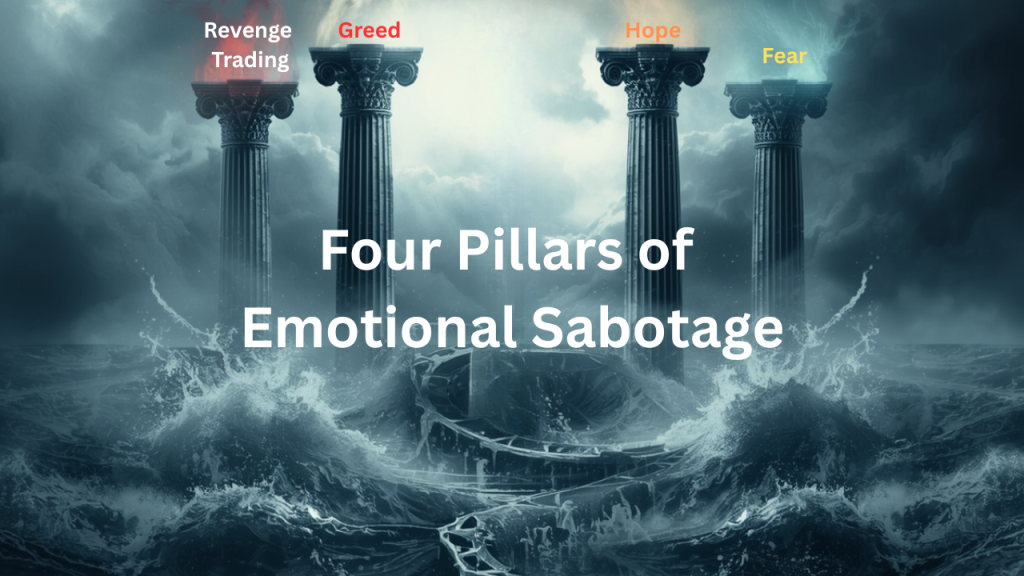
The market is a psychological mirror; it reflects your insecurities and weaknesses back at you with brutal efficiency. While every trader is unique, almost all emotional failures can be categorized into four specific pillars.
1. The Paralyzing Grip of Fear
Fear is the most common inhibitor of emotional control in trading. It manifests in two distinct ways: the fear of losing and the fear of missing out (FOMO). The fear of losing leads to “analysis paralysis,” where a trader sees a perfect setup but hesitates to pull the trigger because they are focused on the potential pain of being wrong. Ironically, the fear of missing out leads to the opposite problem—entering late and at a poor price because the trader cannot stand the thought of others making money without them.
2. The Blinding Effect of Greed
Greed is often mistaken for ambition, but in trading, it is a destructive force. Greed pushes you to ignore your risk parameters and “oversize” your positions. When a trader becomes greedy, they stop seeing the market as a probabilistic environment and start seeing it as a personal ATM. This overconfidence usually precedes a “fat tail” event where a single oversized loss wipes out months of disciplined gains.
3. The Danger of Hope
In almost every other area of life, hope is a virtue. In trading, hope is a terminal illness. Hope is what keeps a trader in a losing position long after their stop loss has been hit. They “hope” for a bounce, “hope” for a news event, or “hope” the market realizes it made a mistake. As we have discussed in the context of Who Succeeds in Proprietary Trading, the professional has no room for hope; they have only the plan and the current reality of price action.
4. The Spiral of Revenge Trading
Revenge trading is an emotional reaction to a loss where the trader attempts to “get even” with the market. It is driven by ego. The trader feels slighted by the market and enters a new position immediately—often with larger size and no valid setup—to recoup the loss. This almost always results in a “tilt” state, leading to a catastrophic drawdown.
Why Even Superior Strategies Fail Without Discipline
A common misconception is that a “better” strategy will solve psychological problems. Traders believe that if they could just find a system with a 90% win rate, they wouldn’t feel fear. This is a fallacy. Even with a high win rate, the inevitable losses will still trigger the same biological responses.
However, the real danger lies in “system hopping.” When a trader lacks emotional control in trading, they blame the strategy for the natural variance of the market. After three consecutive losses—which is statistically normal for any edge—the undisciplined trader abandons the system in search of something “better.” They never allow a strategy to reach a sufficient sample size to prove its expectancy. In reality, the strategy was fine; the “operator” was the point of failure. Discipline is the glue that allows a mathematical edge to actually manifest in a real-world account.
Practical Mechanics of Market Discipline
If you cannot rely on your instincts, you must rely on systems. Professional emotional control in trading is not about “feeling” less; it is about building a framework that prevents feelings from becoming actions.
The Objective Utility of the Trading Journal
A trading journal is not just a record of wins and losses; it is a psychological autopsy. To master your mindset, you must track your internal state at the moment of entry, during the hold, and at the exit. By documenting your “Internal P&L,” you will begin to see patterns. Perhaps you are more prone to revenge trading on Tuesday mornings, or you tend to cut winners early when you haven’t had enough sleep. Data is the only objective weapon you have against subjective emotions.
Position Sizing as a Nervous System Regulator
The most effective way to maintain emotional control in trading is to trade at a size that does not trigger your Amygdala. Every trader has a “financial thermostat”—a dollar amount where the risk becomes “real” enough to cause physical stress. If you are risking 3% of your account and you find yourself staring at every 1-minute candle with a racing heart, your size is too large. By reducing risk to 1% or 0.5%, you keep the Prefrontal Cortex engaged, allowing you to treat the trade as a simple business transaction rather than a life-or-death struggle.
The Power of the Pre-Trade Checklist
Logic is slow; emotion is fast. A pre-trade checklist forces the slow, logical part of your brain to catch up. Before you are allowed to click “buy” or “sell,” you must manually verify that the setup meets every single one of your predefined criteria. This simple act of slowing down can bypass the impulsive “click-finger” that leads to so many unforced errors.
Shifting from Outcome to Process
The final hurdle in achieving emotional control in trading is changing how you define success. An amateur defines success by the outcome of the trade: “I made $500, so I am a good trader.” This is a dangerous way to think because it validates bad behavior if that behavior happens to result in a win.
In addition, a professional defines success by the quality of the process. If you followed your plan perfectly, managed your risk correctly, and still took a loss, that was a “successful” trade. Why? Because you did exactly what was required to preserve your long-term edge. Conversely, if you broke your rules, gambled, and happened to make a profit, that was a “failure.” That “lucky” win is a poison that teaches your brain that it’s okay to be undisciplined. Over time, the professional focus on process creates a calm, detached state of mind that is impervious to the daily noise of the market.
The Ultimate Edge is Internal
Ultimately, the market is an environment designed to transfer wealth from the undisciplined to the disciplined. You can buy the fastest computers, the most expensive data feeds, and the most advanced algorithms, but if you do not have emotional control in trading, you are simply a sophisticated gambler.
The strategy gives you the “what” and the “where,” but psychology gives you the “how.” Mastering your mind is not a one-time event; it is a daily, grueling practice of self-awareness and self-correction. It requires the humility to admit when your ego is in the driver’s seat and the strength to step away from the screens when your emotional capital is depleted. In the end, the most profitable indicator you will ever find is the one looking back at you in the mirror.
More on Trading Psychology
Take the Trader Personality Test
Read:
Psychological Traits of Top Traders: 8 Key Traits You Need to Succeed
10 Essential Skills Every Profitable Trader Must Master
Top 12 Habits of Successful Traders
How to Get Started Trading Options
Disclaimer: This content is provided for educational and informational purposes only. It does not constitute, and should not be relied upon as, personalized investment advice, a recommendation to buy or sell any security, or an offer to participate in any trading activity. Trading involves substantial risk, and past performance is not indicative of future results.