How Professional Traders Think About Risk: The Architecture of Capital Preservation
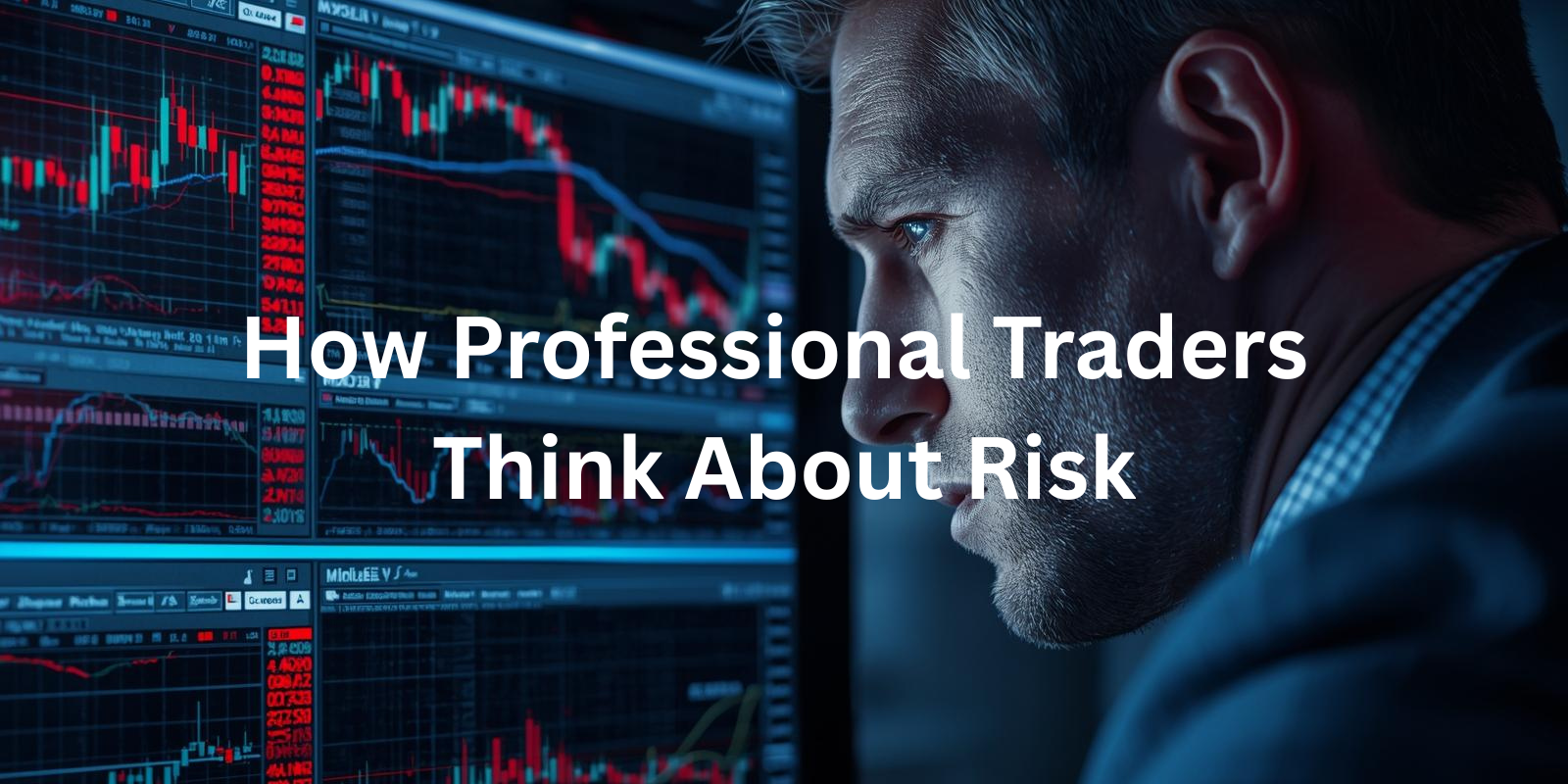
When you step into the world of institutional finance, the first thing you notice isn’t the flashing green lights or the thrill of a big win. Instead, you will see a quiet, methodical focus on the exit. Most retail traders enter a trade wondering how much they can make; however, professional traders manage risk before they ever consider the profit potential. To trade at a professional level, you must undergo a fundamental identity shift. Specifically, you are no longer a “trader” in the speculative sense. You are now a risk manager with a specialized focus on capital markets. This guide explores why professional traders manage risk differently and how you can adopt this mindset to trade firm capital successfully.
To transition from an amateur mindset to a professional one, you must move beyond the basic concept of “using a stop loss.” You must understand how risk interacts with math, psychology, and firm-wide capital allocation.
1. The Win Rate Fallacy: Why Professional Traders Think About Risk First
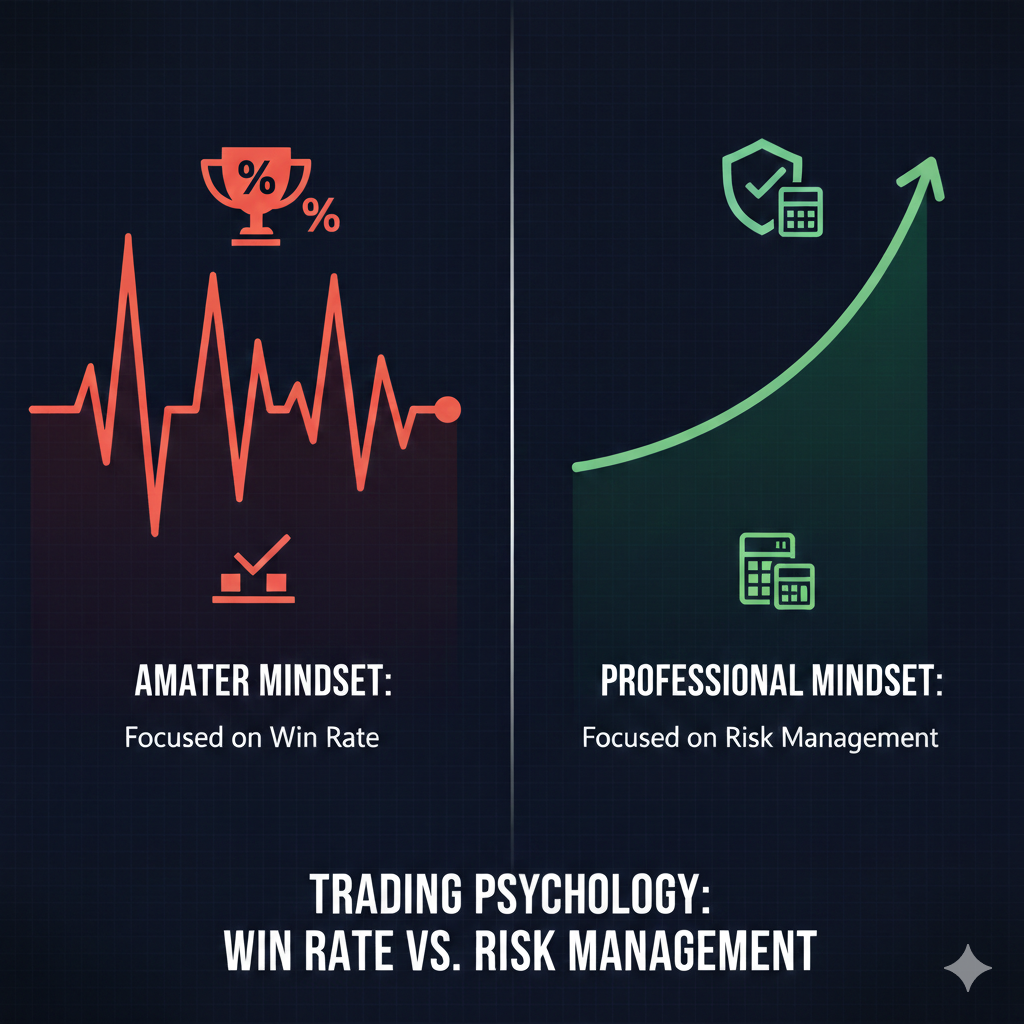
One of the biggest hurdles for developing traders is the obsession with a high “win rate.” In popular media, a successful trader is often portrayed as someone who is “right” 90% of the time. In reality, win rate is a vanity metric that often hides deep structural flaws in a strategy. Consequently, many of the most successful professional traders think about risk in terms of “Expectancy” rather than simple accuracy. While retail traders often chase the psychological high of being “right,” professionals realize that your hit rate matters far less than the mathematical spread of your performance data.
The Mathematical Reality of an “Edge”
An “edge” is not a prediction; it is a statistical advantage that plays out over a large sample size. To understand how professional traders think about risk, you must use the Expectancy Formula to quantify the dollar value of every trade you take:
Connecting the Dots: How to Derive Your Numbers
To calculate this, you cannot guess. You must pull these four variables directly from your trade journal or brokerage “Performance Tab” over a sample of at least 50–100 trades:
-
Pwin(Probability of Win): Total winning trades divided by total trades taken. (e.g., 30 wins / 100 trades = 0.30).
-
Avg Win: The total dollar amount of all winning trades divided by the number of winners. If your 30 wins generated $30,000, your Avg Win is $1,000.
-
Ploss (Probability of Loss): Total losing trades divided by total trades taken. (e.g., 70 losses / 100 trades = 0.70).
-
Avg Loss: The total dollar amount of all losing trades divided by the number of losers. If your 70 losses cost you $14,000, your Avg Loss is $200.
The Result: The Value of a “Click”
When you plug these historical numbers into the formula, you find your Expectancy (E). Using the data above:
-
Gross Gains: $0.30 x $1,000 = $300
-
Gross Losses: $0.70 x $200 = $140
-
Net Expectancy: $300 – 140 = $160
Furthermore, when professional traders think about risk, they realize this $160 is the “hidden value” of every trade they take. Even when they click “buy” and hit a stop-loss for a $200 loss, they know that, statistically, that trade was worth $160 in positive expectancy.
Therefore, a professional will exit a losing trade immediately. They aren’t “giving up” on the position; instead, they are protecting the Avg Loss variable. If they let a $200 loss turn into a $1,000 loss, they destroy the math and turn a winning system into a losing one. Because professional traders think about risk as a rigid calculation of historical averages, they don’t care about the outcome of a single trade—they only care about maintaining the integrity of the spread.
2. Drawdown Control: How Professional Traders Think About Risk in Drawdowns
The single most important concept in institutional trading is the Asymmetry of Loss. This is the mathematical “trap” where most retail accounts go to die. Amateurs often assume that recovering from a loss is a linear process—if you lose 10%, you just need to make 10% back to be even. In reality, the math of capital preservation is non-linear and unforgiving. Consequently, the way professional traders think about risk is centered on preventing the “death spiral” of a deep drawdown.
The Mathematics of the Shrinking Denominator
When you lose capital, your remaining principal (the denominator) becomes smaller. As a result, every subsequent gain has less “leverage” relative to your original starting point. You are forced to produce a higher percentage return on a smaller amount of money just to get back to zero. Because professional traders think about risk using the math of capital contraction, they know that the deeper the hole, the steeper the climb.
Why One “Big Loss” Destroys the Expectancy Model
Recall the expectancy formula we discussed earlier. If your Avg Loss is usually $200, your system is calibrated to handle that. The math dictates that as you lose capital, the percentage required to return to breakeven grows at an accelerating rate. However, if you ignore a stop-loss and let it turn into a 50% account drawdown, you have fundamentally changed the math. You now need a 100% gain just to recover.
Because professional traders think about risk with this asymmetry in mind, they treat a 5% drawdown as a critical threshold. They don’t “double down” to get it back; they scale back their position sizes to slow the rate of loss. They understand that preserving the “trading brick” is more important than catching the next move.
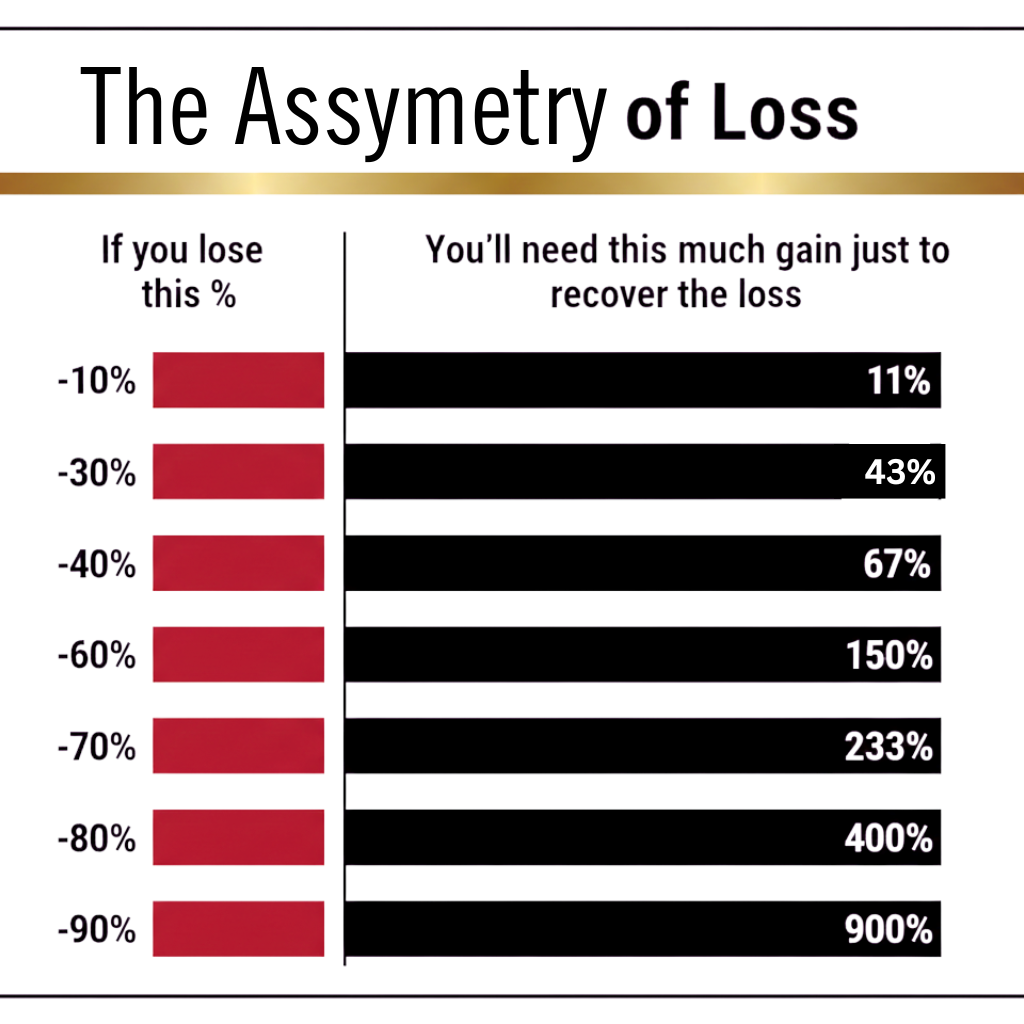
Therefore, a professional manages risk by “cutting the cord” early. They would rather take five small 1% losses than one single 20% loss. Instead of hoping for a miracle recovery, they keep their drawdowns shallow so that the “Gain Required” stays as close to the “Percentage Lost” as possible. Ultimately, professional traders think about risk by protecting the denominator at all costs.
3. The Professional Risk Pyramid: A Three-Tiered Defense
A professional’s risk management is not a single rule; it is a layered defense system. When professional traders think about risk, they visualize it as a pyramid where the foundation must be indestructible.
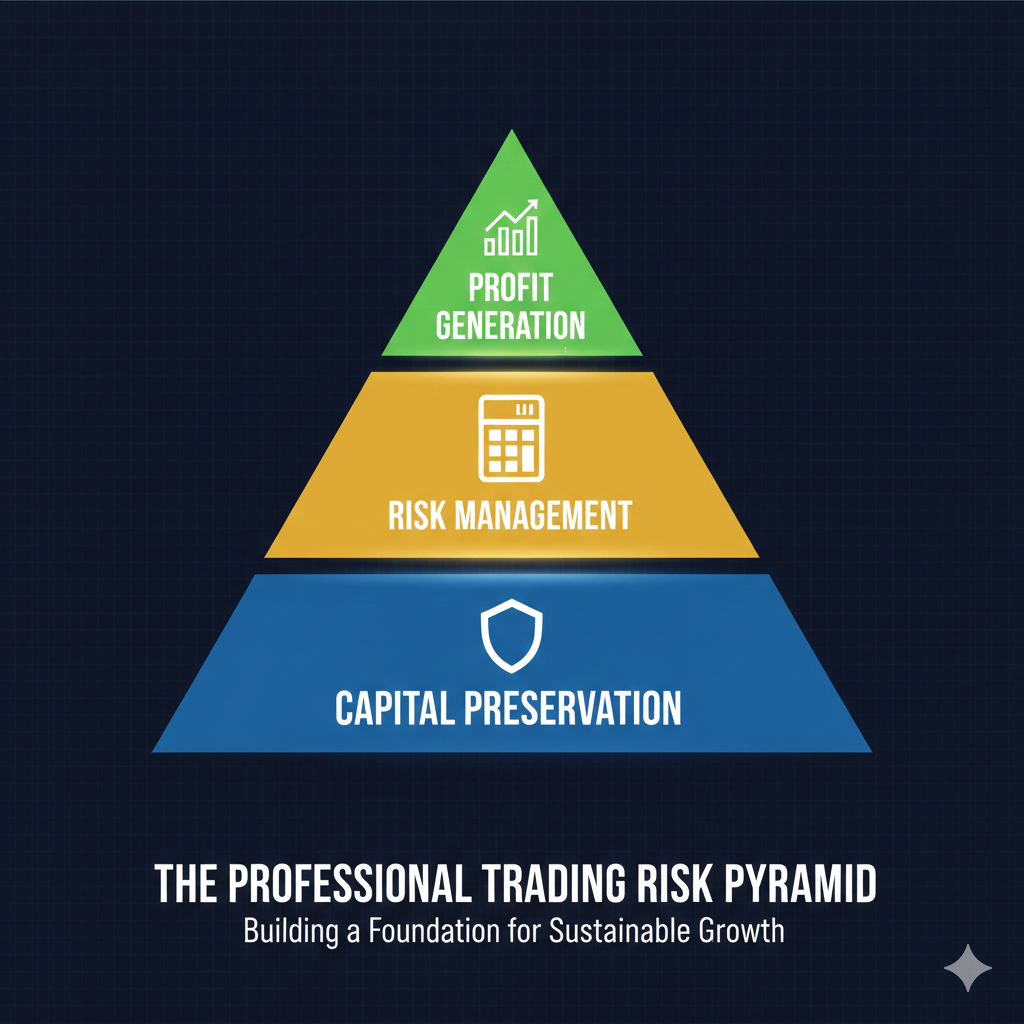
Tier 1: Systemic Risk and Correlation
Diversity is often misunderstood. If you are long 10 different stocks that all have a high correlation to the S&P 500, you aren’t diversified—you are simply 10x leveraged on a single theme. Professional traders think about risk by analyzing the correlation of their entire portfolio. They ensure that a single sector move doesn’t trigger a cascading liquidation across their entire account.
Tier 2: Position Sizing and the 1% Rule
The “1% Rule” is the industry standard for a reason. By risking only 1% of total equity on any single trade, a trader ensures that even a catastrophic “losing streak” of 10 trades leaves them with 90% of their capital intact. This is the bedrock of professional capital allocation.
Tier 3: Tactical Execution
This is where the stop-loss lives. Professional traders think about risk by identifying the “point of invalidation”—the price level where their thesis is proven wrong. If the price hits that level, the trade is dead. There is no “waiting for it to come back.”
4. Market Friction: Liquidity and Slippage
Beyond the chart, professional traders think about risk in terms of market mechanics. For a professional managing a larger capital base, the act of entering and exiting a position creates “market impact.”
Liquidity Risk
Amateurs often trade low-volume options because of perceived leverage. Professionals avoid these “liquidity traps.” They know that getting into a position is easy, but getting out during a panic is impossible in a thin market. Professional traders think about risk by ensuring they are never more than a small percentage of the average daily volume of any instrument.
Execution Risk
In a fast-moving market, your stop-loss is not a guarantee; it is a “market order” triggered at a certain price. “Slippage”—the difference between your desired exit price and the actual fill—can turn a 1% risk into a 3% disaster. Professionals factor slippage into their models.
5. Psychological Volatility and “Internal Risk”
Risk isn’t just in the price action; it’s in the person sitting behind the terminal. Professional traders think about risk as an internal metric. They monitor their own “emotional drawdown.”
The Hazard of “Revenge Trading”
After a loss, the human brain enters a “fight or flight” mode. An amateur trader will often increase their risk to “make back” the loss. A professional recognizes this biological impulse and walks away from the screen. They know that their decision-making quality is a risk factor that must be managed as closely as their margin usage.
6. Risk as a Business Expense
In professional trading, we don’t look for the trader who made 500% in a month; we look for the trader who has the smallest standard deviation in their equity curve. Professional traders think about risk as the “Cost of Goods Sold” (COGS).
In any other business, you have expenses—rent, payroll, inventory. In trading, your expense is the stop-loss. If you cannot accept the “cost” of a trade, you cannot run the business.
The Professional Mandate
Mastering the Professional Mandate
In conclusion, the difference between a gambler and a professional is the focus. One is obsessed with the potential of the “next big trade.” Meanwhile, the other is obsessed with the protection of the “current capital base.”
When professional traders think about risk, they are acknowledging a fundamental truth: the market is unpredictable, but their response to it must be entirely predictable. By mastering the asymmetry of loss, respecting the risk pyramid, and maintaining a systematic approach to expectancy, you move from the ranks of the retail herd into the world of professional finance. Ultimately, professional traders think about risk to ensure they are still in the game tomorrow.
More on Trading Psychology
Take the Trader Personality Test
Read:
Psychological Traits of Top Traders: 8 Key Traits You Need to Succeed
10 Essential Skills Every Profitable Trader Must Master
Top 12 Habits of Successful Traders
How to Get Started Trading Options
Disclaimer: This content is provided for educational and informational purposes only. It does not constitute, and should not be relied upon as, personalized investment advice, a recommendation to buy or sell any security, or an offer to participate in any trading activity. Trading involves substantial risk, and past performance is not indicative of future results.